
If you search for "GPT-6 API" in July 2026, you will probably land on prediction posts with specific dates, Polymarket odds screenshots, and feature lists OpenAI has not confirmed. As someone maintaining production integrations, I care about three practical questions: when the GPT-6 API will actually be callable, where GPT-6 API pricing is likely to land, and what migration work is worth doing now.
Bottom line first: as of July 30, 2026, there is no GPT-6 endpoint in OpenAI's official model catalog. The current flagship line is the GPT-5.6 Sol / Terra / Luna family, which reached GA on July 9. OpenAI has disclosed, in safety evaluations, that a stronger pre-release model exists beyond GPT-5.6 Sol, and Sam Altman has previewed capabilities to regulators — which means GPT-6 API docs are coming, just not on a day when you can safely flip a model field in production.
This article separates confirmed facts from reasonable speculation and turns both into an actionable migration plan — not another "definitely shipping in August" rumor roundup.
GPT-6 API status: confirmed vs. still speculative
Separating "OpenAI has said" from "the market is betting" is step one in any migration plan. The table below classifies what was publicly known as of late July 2026:
| Event / claim | Status | What it means for developers |
|---|---|---|
| GPT-5.6 Sol / Terra / Luna API GA (2026-07-09) | ✅ Confirmed | Production should standardize on this line; the gpt-5.6 alias points to Sol |
| Safety evaluation references a "stronger pre-release model" (2026-07-21) | ✅ Confirmed | A next-generation model exists in internal/regulatory channels, but no public model ID yet |
| Polymarket odds on public GPT-6 release before Sep 30 | 📊 Market prediction | Useful context — do not write into SLAs or product roadmaps |
| "Spud" codename shipped as GPT-5.5, not GPT-6 (2026-04-23) | ✅ Confirmed | OpenAI may keep iterating with point releases; version jumps may not match community expectations |
| Exact GPT-6 API pricing figures | ❌ Not published | Any precise quote is speculation; see the range estimate below |
My read: the most credible window is late Q3 2026 through Q1 2027 — a developer preview may arrive before ChatGPT gets full consumer rollout. Rather than watching a calendar, watch three signals: a new model ID in the OpenAI API Changelog, a new series on the Models page, and the accompanying System Card plus migration guide. Those three usually land 24–72 hours before social media noise — enough lead time to stage a canary.
Teams that treat prediction-market dates as engineering deadlines tend to over-invest in placeholder abstractions and under-invest in the Responses API work that actually de-risks the jump. The timeline is uncertain; the integration surface is not. If your roadmap already says "GPT-6 in August," relabel it "Responses migration complete by August" — that is the milestone you control.
Internal previews, if they follow past patterns, may appear under non-obvious model IDs or org-gated allowlists before public GA. Do not block current shipping on rumor access; do use the window to harden observability (per-request token breakdown, model ID in structured logs, cost attribution by feature flag) so a future swap is measurable.
GPT-6 API pricing: how to estimate your bill
Until OpenAI publishes official GPT-6 API pricing, the most reliable approach is to extrapolate from the previous generation's curve and budget extra headroom for reasoning tokens. GPT-5.6 standard short-context rates as of July 2026 look like this:
| Model | Input (/1M tokens) | Output (/1M tokens) | Cached input |
|---|---|---|---|
| gpt-5.6-sol (flagship) | $5.00 | $30.00 | $0.50 |
| gpt-5.6-terra (balanced) | $2.50 | $15.00 | $0.25 |
| gpt-5.6-luna (low cost) | $1.00 | $6.00 | $0.10 |
The full rate card lives on the OpenAI API Pricing page, including long-context multipliers (2× input / 1.5× output), Batch half-price, Priority 2×, and related rules.
Using the GPT-4 → GPT-5 price step and GPT-5.6's cache-write billing at 1.25×, my working range for GPT-6 API pricing is:
- Flagship tier (likely gpt-6-sol): input $6–10 / 1M tokens, output $35–50 / 1M tokens
- Balanced tier (likely gpt-6-terra): roughly 50% of flagship
- Low-cost tier (likely gpt-6-luna): roughly 20% of flagship
- Reasoning surcharge: when
reasoning.effortisxhighormax, orreasoning.mode: prois enabled, bills may rise another 30%–80%
Budget impact rarely hinges on "a few dollars per million tokens." It hinges on call shape. If GPT-6 defaults to cross-turn reasoning persistence (similar to GPT-5.6's reasoning.context: all_turns), long-running Agent conversations can burn far more hidden tokens than one-shot Q&A. Before launch, pull cached_tokens and reasoning_tokens breakdowns from your existing GPT-5.6 traffic. With that baseline, new pricing becomes an ROI calculation — not a panic switch the week docs drop.
Also model discounts you already rely on: prompt caching, Batch API, and tier selection. A team running Luna with Batch on summarization workloads may see a smaller percentage jump than a Sol + pro-reasoning coding Agent fleet. Run the scenario both ways when leadership asks for a "GPT-6 budget line item."
A simple spreadsheet model helps: take last month's input/output/reasoning/cached token volumes, apply GPT-5.6 rates for a control total, then layer the speculative GPT-6 range on the same volumes before adjusting for expected reasoning uplift. Finance teams prefer a band ("+15% to +40% at constant traffic") over a single guessed price point. Revisit the sheet when official GPT-6 API pricing publishes — one afternoon of spreadsheet work beats a quarter of surprise overages.
What the GPT-6 API might add
OpenAI has not shipped GPT-6 API docs yet. Still, GPT-5.6's exposed API surface, OpenAI's product direction over the past year, and regulatory disclosures about a stronger pre-release model give us a reasonable sketch — even "high probability" items below remain inference until documentation lands:
Multi-Agent orchestration and longer task chains
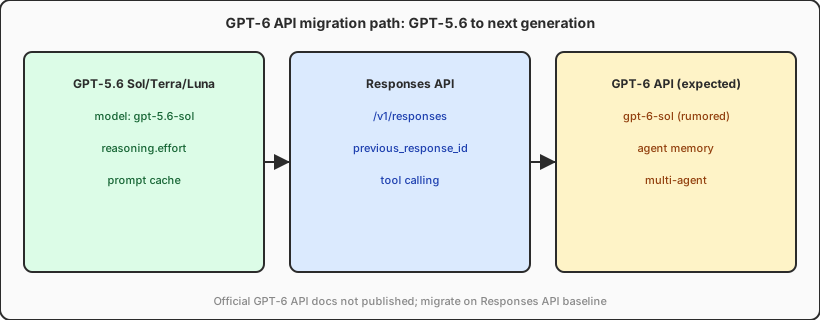
GPT-5.6 already supports Programmatic Tool Calling and previous_response_id state handoff in the Responses API. GPT-6 may elevate "sub-Agent specialization + lead Agent synthesis" to first-class primitives, cutting the custom orchestration code many teams maintain today. If you are automating tool chains, read our piece on AI Agent cross-session memory — it explains engineering patterns for state persistence and the "amnesia" problem when Agents span sessions.
Persistent memory API
Memory in the ChatGPT product is mature, but the API layer still lacks a product-parity primitive for user-level long-term memory. If GPT-6 closes that gap, RAG architectures will split: simple flows might use an official memory store; regulated or multi-tenant setups will still need self-hosted vector databases. Do not rip out existing RAG until GPT-6 API docs spell out data residency, retention, and deletion guarantees.
Finer-grained reasoning tiers
GPT-5.6 already exposes six reasoning.effort levels from none through max, plus standard and pro under reasoning.mode. GPT-6 might add task-type auto-routing (dynamic effort selection). For migration, that means hard-coded effort: high call sites could suddenly get slower or more expensive post-launch — plan a re-eval pass, not a blind model swap.
Multimodal and real-time toolchains
Video understanding, computer use, and real-time voice have been landing across GPT-5.x APIs. A GPT-6 generation jump is more likely to improve multimodal reasoning quality and tool-call success rates than to introduce an entirely new endpoint family — the Responses API will probably remain the primary integration surface.
Migrating from GPT-5.6 to GPT-6: a practical checklist
Many teams conflate "move to GPT-6" with "move to the Responses API." In practice, the Responses migration is the urgent engineering task for the second half of 2026; swapping model IDs after GA is often a configuration change. Prioritized steps:
Step 1: Finish the Responses API migration (do this now)
If your code still calls POST /v1/chat/completions, work through the Migrate to the Responses API guide item by item:
- Switch the endpoint to
POST /v1/responses - Map
messagestoinputandoutputitem arrays - Replace
response_formatwithtext.format(Structured Outputs) - Pick one multi-turn strategy:
previous_response_id, manual replay, or the Conversations API - Update streaming consumers to Responses event types
Chat Completions remains supported for now, but newer capabilities — including GPT-5.6 reasoning defaults and Programmatic Tool Calling — are more complete on Responses. Staying on Completions through the GPT-6 launch is voluntary technical debt.
Practical tip: migrate one low-risk internal service first — an internal summarizer or classification worker — before touching customer-facing chat. You will surface mapping quirks (tool schemas, streaming event handlers, error shapes) without betting the core product. Keep Completions and Responses paths behind a feature flag until parity is proven on production-like traffic.
Step 2: Pin model snapshots and abstract configuration
If gpt-5.6-sol is hard-coded across dozens of files, GPT-6 launch day will hurt. Recommended habits:
- Manage
OPENAI_MODELvia environment variables or a config service - Use snapshot IDs in production (e.g.
gpt-5.6-sol-2026-07-09) to lock behavior - Add CI linting that fails on scattered model string literals
Step 3: Build an eval baseline before you switch
Moving from GPT-5.6 to GPT-6 deserves at least one pass over representative traces: code generation, support replies, JSON structured output, and tool-call success rates. OpenAI's Latest model guidance recommends starting from your current reasoning.effort baseline and stepping down to test cost — not opening with max on day one.
Step 4: Canary strategy after GPT-6 GA
A typical safe rollout:
- Run the new model ID in staging for 48 hours; compare P95 latency and error rates
- Canary 5% of production traffic; watch
finish_reason, tool-call failures, and cost per request - Roll forward after no regressions; keep the old snapshot available for two weeks
- Update internal runbooks with tier guidance (Sol for heavy reasoning, Terra for balance, Luna for batch)
If you are standing up isolated environments and secret management for AI tooling, see the short-cycle AI tooling decision matrix — when GPT-6 traffic spikes, quota and environment planning matter more than the model string.
GPT-6 API docs: pages to watch before launch
There is no standalone GPT-6 API docs microsite today. On launch day, information usually appears in this order — bookmark these and monitor Changelog via RSS or a CI webhook:
- Models (
developers.openai.com/api/docs/models) — new model IDs and context windows - Pricing — official GPT-6 API pricing numbers
- Changelog — release notes and breaking changes
- Latest model guidance — default
reasoning.effortvalues and migration notes - System Card — capability boundaries and safety evaluation summary
Do not trust third-party "GPT-6 API docs mirror" sites. OpenAI documentation supports appending .md to URLs for Markdown exports and publishes an llms.txt index — those are the inputs you want when automating migration scripts.
When the model ID appears, read Changelog and Latest model guidance in the same sitting. Breaking changes to reasoning defaults have shipped quietly in past releases; treating "model listed" as "drop-in replacement" has burned teams who skipped the guidance page.
Set up a lightweight doc-diff job: fetch Models and Changelog Markdown weekly (or on webhook), diff against the previous snapshot, and post to Slack when new GPT-6 strings appear. The first engineer who sees the alert should own a same-day spike: hello-world call, token usage sample, and a one-page internal brief — not a company-wide migration announcement before anyone has run an eval.
Which model should you run today? A decision table
| Your scenario | Recommended in July 2026 | After GPT-6 launches |
|---|---|---|
| Production API, stability first | gpt-5.6-sol + snapshot |
Canary gpt-6-sol, keep rollback path |
| Cost-sensitive, high concurrency | gpt-5.6-luna + Batch |
Wait for gpt-6-luna pricing before switching |
| Complex reasoning / code Agents | gpt-5.6-sol + reasoning.mode: pro |
Re-eval; may default up to GPT-6 after benchmarks |
| Legacy Completions integration | Migrate to Responses; interim gpt-5.6-terra |
Otherwise GPT-6 rework cost roughly doubles |
| ChatGPT personal use only | No API migration needed | Watch whether Plus/Pro bundles include new models |
One sentence summary: what belongs in production config today is GPT-5.6 plus the Responses API; GPT-6 is the next configuration change, not the next architecture rewrite.
Five mistakes teams make before migrating
- Putting prediction-market dates on the project plan — Polymarket at 70%+ is not an OpenAI SLA. Leave slack in the schedule.
- Waiting for GPT-6 while skipping Responses API — both generations share Responses as the integration base; migrate API shape first, model second.
- Ignoring reasoning token line items — GPT-5.6 made inference cost visible; GPT-6 will not make it cheaper to run
maxeffort on bulk summarization. - Chasing aliases without snapshots — the
gpt-6alias may drift with minor releases; production needs snapshot IDs to lock behavior. - Announcing "GPT-6-ready" without eval data — stakeholders hear "new model" and expect magic; publish benchmark deltas (quality, latency, cost) from your own traces, not launch-day hype threads.
Closing thought: the GPT-6 API is the model generation worth tracking in 2026, but until official GPT-6 API docs and GPT-6 API pricing land, the highest-leverage work is running GPT-5.6 reliably, finishing the Responses API migration, and building eval baselines plus cost monitoring. Do that, and launch day is a config change — not a rewrite.
GPT-6 canaries still need a stable build environment
Planning a GPT-6 API rollout often means staging runs eval scripts, Agent toolchains, and iOS/macOS build pipelines at the same time. If your AI product depends on Xcode, TestFlight, or macOS-only signing tools, pure Linux CI cannot cover the full release path.
VPSSpark cloud Mac mini M4 fits a split architecture: AI backends in the cloud, Apple client builds on a cloud Mac — low power draw, always-on friendly, native Unix tooling that pairs cleanly with OpenAI API integration debugging. Running GPT-6 canaries on an isolated staging cloud Mac beats juggling environment variables and key leakage risk on a daily-driver laptop.