In July 2026, three stories hit tech headlines almost at once:
- Anthropic was reported to be in talks with Samsung to manufacture custom AI chips on a 2nm process;
- OpenAI and Broadcom's Jalapeño inference chip entered real-world testing;
- Apple jumped its private cloud servers from M2 Ultra straight to M5, and is preparing dedicated AI server silicon.
If you mostly write code and call APIs, you might wonder: what does the "AI chip war" have to do with me? I'm not building chips.
It matters more than you think—every time you call Claude, ChatGPT, or Apple Intelligence, some chip (or tens of thousands of them) is burning power. When chips get pricier and scarcer, API pricing, service reliability, and on-device experience get shakier. This article explains the whole story in plain language.
Two basics first: what are chips computing? Training vs inference
Large models aren't magic—they're essentially massive matrix multiplication. A chip's job is to finish that math as fast and as efficiently as possible.
| Phase | Plain-language view | Compute profile | Typical hardware |
|---|---|---|---|
| Training | Teaching the model to "study for an exam"—language and reasoning | Huge one-time spend; clusters run for weeks | NVIDIA H100/H200, Google TPU, AWS Trainium |
| Inference | Every user question; the model "speaks up" | Runs 24/7; cost stacks per request | GPU, TPU, and vendor custom ASICs |
Key takeaway: the 2026 custom-chip wave's main battlefield is inference—more users and longer chats mean inference bills climb linearly or worse. OpenAI's Jalapeño and Apple's M5 private cloud both optimize "cost and speed per answer."
Think of training as building the factory and inference as the electricity bill once it opens. If power stays expensive, the product stays expensive.
Three terms you should know
- GPU (graphics processing unit)
- NVIDIA H100/H200 is today's default answer for AI training. Strong parallelism, but expensive, power-hungry, and often supply-constrained.
- TPU (tensor processing unit)
- Google's custom AI chip, built for matrix math. Anthropic uses TPUs heavily through Google Cloud.
- ASIC (application-specific integrated circuit)
- Silicon tailored to a specific AI workload. OpenAI Jalapeño and Apple's rumored Valtra fit here—trade generality for efficiency and cost.
Why did everyone suddenly "build chips" in 2026?
On the surface, NVIDIA's dominance: after the AI boom, GPU lead times stretched years and prices stayed high. Deeper drivers:
- The model is the product — ChatGPT, Claude, and Gemini compete on who can run models cheaper and more reliably.
- Hardware–software co-design — once architectures like Transformer attention stabilize, custom chips can drop GPU logic you never use.
- Supply-chain security — relying on one vendor means handing them your lifeline; multi-cloud, multi-chip is standard for hyperscalers.
Industry note: chip design to mass production usually takes 2–4 years. "Talks," "tape-out," and "pilot deploy" headlines in 2026 mostly shape 2027–2028 API cost and supply—not next week's bill.
One table: who uses what?
| Player | Training backbone | Inference strategy | Custom silicon (2026) |
|---|---|---|---|
| OpenAI | NVIDIA GPU | Jalapeño ASIC (Broadcom fab) | Announced; target -50% inference cost; small rollout late 2026 |
| Anthropic | AWS Trainium + NVIDIA | Google TPU + future in-house | Samsung 2nm talks; ~3.5 GW TPU deal with Google/Broadcom (from 2027) |
| In-house TPU | TPU + GPU mix | Broadcom partnership extended to 2031 | |
| Apple | No external training clusters | M series + Private Cloud Compute | M5 PCC servers; dedicated AI chip mass prod. H2 2026 |
| Amazon | Trainium | Inferentia | Cloud option; Anthropic training partner |
| Meta / Microsoft | NVIDIA + in-house | MTIA / Maia | Mostly for own models and Azure |
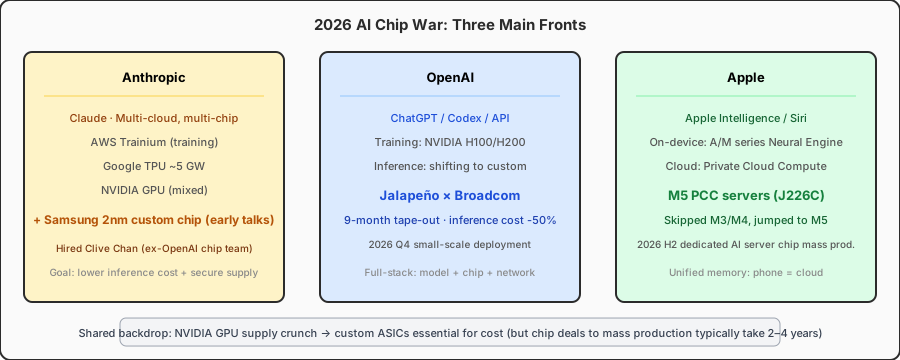
Anthropic × Samsung: from "using others' chips" to designing their own
Background: Claude grew fast; compute had to keep up
Anthropic's annualized revenue passed $30 billion in early 2026 (up sharply from roughly $9 billion at end-2025). The more popular the model, the easier inference clusters become the bottleneck.
Before the Samsung headlines, Anthropic's compute map was already diverse:
- AWS: primary cloud and training partner (Project Rainier, etc.);
- Google Cloud: about 1 GW of TPU from October 2025, scaling ~3.5 GW more from 2027;
- NVIDIA GPU: mixed with Trainium and TPU by workload.
Official line: Claude is one of few frontier models on AWS, Google Cloud, and Azure—multi-chip is resilience, not picking sides.
Samsung talks: what happened?
On July 2, 2026, The Information cited multiple sources:
- Anthropic is talking with Samsung Electronics about custom AI chips on Samsung's 2nm (SF2) process and advanced packaging;
- The project is very early: specs, power, rack form factor unset; no tape-out or production schedule;
- Anthropic is also talking to other design partners and could drop in-house silicon.
Notable signals:
- Hiring — In June 2026, Anthropic hired Clive Chan (ex–OpenAI and Tesla custom-chip projects)—moving from "asking around" to "building a team."
- Investment context — May 2026 Series H brought Samsung, SK hynix, and Micron as "strategic infrastructure partners"; Samsung is the only one with both memory and foundry.
- Samsung's motive — years of foundry losses; needs Anthropic, Tesla, Apple-class customers to prove 2nm and packaging.
Does this conflict with the big Google TPU deal?
No—it's a layered strategy:
- Short term (2026–2027): Google TPU, AWS, NVIDIA carry growth;
- Medium/long term: successful custom inference silicon could cut cost on specific Claude workloads and reduce single-vendor risk.
For everyday users: Claude API pricing won't drop overnight because of Samsung news. Real levers are 2027+ TPU capacity delivery and whether custom chips reach production.
OpenAI Jalapeño: the first inference chip "tailored for ChatGPT"
Launch highlights (June 24, 2026)
OpenAI and Broadcom announced Jalapeño:
| Dimension | Details |
|---|---|
| Role | Inference-only ASIC—not for large-model training |
| Dev cycle | About 9 months design to tape-out (both sides call it a record; AI-assisted design internally) |
| Cost target | Early tests show inference cost ~50% lower vs typical GPUs |
| Rollout | Late 2026 small pilot; scale 2027; larger 2028 target |
| Partners | Broadcom on silicon and networking (incl. Tomahawk); Celestica on boards and racks |
OpenAI was blunt: they're not only building models and products—they're designing chip architecture, kernels, memory, networking, scheduling—full-stack optimization so models run "faster, steadier, cheaper."
Training still runs on NVIDIA
Jalapeño cannot replace backprop in training clusters. OpenAI stays on NVIDIA training + custom inference—like Google (TPU for own models + GPU fill-in) and Anthropic (Trainium/TPU/GPU mix).
What it means for developers
- APIs: if inference cost really drops 50%, there's long-term room for lower prices or more capacity without worse quality (after R&D and deploy payback).
- Competition: Google, Anthropic, and Meta all push own silicon; OpenAI can't compete only on models—they must win on marginal cost per call.
- What you can do: keep using APIs; self-hosted inference still works on Docker plus consumer GPU or Mac for smaller models—in parallel with hyperscaler paths.
Apple: on-device Neural Engine + M5 private cloud + future Valtra
Apple's playbook isn't identical to OpenAI/Anthropic—Apple doesn't sell cloud APIs; chips serve Apple Intelligence.
Private Cloud Compute (PCC): skip M3/M4, jump to M5
Apple's private cloud handles AI when on-device compute isn't enough (complex Siri, large context, etc.) with privacy and encryption.
Early 2026 code and firmware leaks showed:
- New hardware J226C with M5;
- PCC had long used M2 Ultra; M3 Ultra never rolled out at scale;
- iOS 26.4 adds PCC Agent Worker—smoother device/cloud routing users barely notice.
Why skip two generations? Analysts argue M5's chiplet design stacks better into dense, efficient server nodes and shares silicon with MacBook Pro / Mac Studio—one architecture to maintain.
Dedicated AI server chip (Valtra rumors)
Supply-chain sources (e.g. Ming-Chi Kuo): H2 2026 mass production of a dedicated AI server chip, 2027 datacenter deploy—a step beyond "put M5 in a rack," closer to pure ASIC, possibly Broadcom co-design.
Google Gemini partnership
Apple confirmed some Siri capabilities run on Google Gemini. Stronger M5 PCC supports hybrid routing: sensitive steps on Apple cloud, some model capability via Gemini—better hardware controls latency and cost.
Developer angle: why Cloud Mac still matters
- iOS / macOS / Apple Intelligence work still needs Xcode and device debugging—separate from datacenter AI silicon;
- MLX, Core ML on Apple Silicon share unified-memory thinking with PCC—local profiling should align better with future cloud behavior;
- Linux VPS for Agents and backends, Cloud Mac for Apple builds—still a common split.
Is NVIDIA still a monopoly?
In training: still the default. No frontier lab in 2026 fully walks away from NVIDIA training clusters.
But dominance is shifting from "only option" to "the most expensive piece":
- Inference share eroded by TPU, Trainium, Inferentia, and ASICs;
- Hyperscalers trade gigawatt orders for pricing and capacity;
- Samsung, Intel, and TSMC customer diversity leaves room for a "second supplier."
For individual developers: you can't buy H100s, and you don't need to—watch API pricing and open small models on local/VPS value.
Common myths (beginner edition)
Myth vs reality
| Myth | Reality |
|---|---|
| "Anthropic already runs Samsung chips" | As of July 2026, early talks only—no production silicon |
| "Jalapeño will train GPT-6" | Inference only; training stays on NVIDIA |
| "Apple M5 = NVIDIA killer" | M5 PCC serves Apple's ecosystem—no public compute for sale |
| "Custom chips = free APIs next year" | R&D, tape-out, datacenter retrofit take time—2–4 years to hit pricing |
| "I should hoard GPUs" | For personal use, APIs or single-GPU inference suffice; hoarding is crypto-mining thinking |
- ASIC or GPU—which should I pick?
- You don't pick—cloud vendors do. You pick APIs, self-hosted stacks, or inference frameworks on Mac/Linux.
- What does 2nm mean?
- Smaller process numbers usually mean denser transistors and better efficiency. Samsung 2nm is foundry marketing; Anthropic cares about yield at scale and packaging that puts memory next to compute.
Timeline: one calendar for the headlines
| Date | Event |
|---|---|
| 2025-10 | Anthropic expands Google TPU; ~1 GW online 2026 |
| 2026-04 | Anthropic + Google + Broadcom deal; ~3.5 GW TPU from 2027 |
| 2026-05 | Anthropic Series H; Samsung/SK hynix/Micron invest |
| 2026-06 | OpenAI launches Jalapeño; Anthropic hires Clive Chan |
| 2026-07 | Press reports Anthropic–Samsung 2nm talks |
| 2026 Q4 | Jalapeño small-scale deploy (planned) |
| 2026 H2 | Apple dedicated AI server chip mass prod. (supply-chain forecast) |
| 2027+ | TPU scale-up, Jalapeño ramp, Apple Valtra deploy (planned) |
What should you do? Three practical tips
1. Keep APIs as the default
Chip-war winners at scale are billion-user companies. Individuals and small teams using Claude/OpenAI APIs still beat building H100 clusters.
2. Self-host with VPS + Docker, not chip design
Run Agents, Open WebUI, n8n, etc. on an Ubuntu LTS VPS + Docker—still the lowest-friction path in 2026. Chip news doesn't change that.
3. Apple developers: care about device–cloud consistency, not foundry gossip
M5 and PCC upgrades should make the same model optimizations closer on iPhone and cloud. App builders should follow WWDC and Core ML—not Samsung fab rumors.
Bottom line: the 2026 AI chip war is really an inference cost war. Anthropic talks Samsung, OpenAI ships Jalapeño, Apple upgrades M5 private cloud—different shapes, same logic: ~~burn unlimited cash for growth~~ use custom silicon to cut marginal cost per conversation. You don't need to understand lithography—just that compute is becoming strategic and expensive, while your fight stays in product, workflow, and infrastructure choices.
FAQ
Beginner: how are AI chips different from a normal PC CPU?
CPUs excel at complex logic and branches (OS, browser). AI chips (GPU/TPU/ASIC) excel at **repeating the same operation billions of times** (matrix multiply). ~90% of large-model inference is the latter—so specialized silicon saves power and money.If Anthropic already has Google TPU, why Samsung?
TPU is rented Google-ecosystem compute; custom design + Samsung fab is **owning your inference chip blueprint**. Another path means another bargaining chip on cost—but the project can still fail or slip.Will OpenAI Jalapeño make my ChatGPT faster?
In theory—if inference clusters migrate to Jalapeño and stability holds, the same hardware budget supports more concurrency. What you feel depends on rollout; **2026 is mostly internal testing**.I'm an indie dev—learn chips or Docker?
Learn Docker. Chips are pushed by giants and foundries; what you control is **how you call models, Agent architecture, and deploy environments**. Before you hit Ctrl + C on a tutorial, know whether you're on Linux or macOS.Where can I cross-check these stories?
Compare multiple sources: OpenAI and Anthropic blogs, Broadcom SEC filings, The Information / Reuters coverage, and Apple's open PCC-related code commits. One leak isn't enough to judge production timing.Chips live in the cloud—your battlefield is infrastructure
AI giants fight over datacenter compute; individuals and small teams need a Linux VPS that runs Agents, Docker, and self-hosted models 24/7.
When you need Xcode and iOS builds, VPSSpark Cloud Mac completes the Apple side—Linux for services, Cloud Mac for builds, two tracks that complement each other.