
Bottom line first: If you already rely on Claude Code but your monthly bill makes you hesitate, the most practical move is not to switch tools—it is to route Claude Code through OpenRouter. Send everyday completions and small edits to DeepSeek, keep Claude for complex refactors and cross-file changes, and hand gnarly reasoning to GPT. Three environment variables get you connected, and most developers can cut monthly AI coding spend to a third of what they pay today—or less.
This article is for three audiences: full-time developers on Claude Pro or Max who regularly hit usage caps; indie builders who want to try Claude Code but fear runaway token billing; and tech leads who own AI tooling budgets and need a quantifiable way to make claude code cheaper without ripping out the workflow.
Why Claude Code is powerful—and expensive over time
Claude Code is one of the best terminal AI coding assistants available: it reads your whole repo, calls your toolchain, runs tests, and opens PRs. The rhythm feels like pairing with a senior engineer at the next desk. That agent-style workflow also shapes the cost structure—it is not “ask one question, get one answer.” Every turn resends context, file trees, and tool output back to the model, so token use dwarfs ordinary chat.
If you connect straight to the Anthropic API or rely on Claude Pro / Max, a typical day might look like this: morning architecture work on a module (Sonnet or Opus tier), midday edits across a dozen files (many tool rounds), afternoon debugging a weird concurrency bug (long context plus reasoning). Light users might spend a few dollars; heavy users blow past ten or twenty dollars in a single day. Monthly, that is often an order of magnitude more than a fixed Copilot or Cursor subscription.
The hidden waste is using a flagship model for everything: Opus to rename a variable, add one import, or explain code that already has comments—quality matches Haiku or DeepSeek, but the price is five to ten times higher. Many developers do not need to quit Claude Code; they need a way to match models to task severity. That is where OpenRouter shines as a claude code alternative routing layer—you keep the agent, you swap the backend.
What is OpenRouter—and why it fits Claude Code?
OpenRouter is a model aggregation gateway: one API key gives you Anthropic, OpenAI, Google, DeepSeek, Meta, and dozens more, billed per call. For openrouter claude code setups, three advantages matter most.
First, native Anthropic protocol support. Claude Code already speaks the Anthropic Messages API. OpenRouter exposes an Anthropic-compatible endpoint, so you do not need a local proxy or Docker—change a few environment variables and traffic moves from api.anthropic.com to openrouter.ai/api. The full walkthrough lives in the OpenRouter Claude Code integration guide.
Second, you can swap models per slot. Claude Code internally assigns roles: default conversation (Sonnet slot), fast lightweight work (Haiku slot), sub-agents, and more. With ANTHROPIC_DEFAULT_SONNET_MODEL, ANTHROPIC_DEFAULT_HAIKU_MODEL, and CLAUDE_CODE_SUBAGENT_MODEL, you can point the Haiku slot at DeepSeek, keep Sonnet on Claude, and route sub-agents to GPT—the UX stays the same; only the backend changes.
Third, one bill and flexible top-ups. Teams skip juggling Anthropic, OpenAI, and DeepSeek accounts separately. The OpenRouter dashboard breaks spend down by model and project, which makes budget caps practical. For individuals, preloading $10–20 often lasts weeks—more predictable than a Claude Max subscription when usage spikes.
Three steps: point Claude Code at OpenRouter
The whole setup is three environment variables—no local proxy required. Add the block below to ~/.zshrc (or ~/.bashrc), or put it in .claude/settings.local.json at the project root. Note that Claude Code does not read ordinary .env files.
# OpenRouter API Key (create at openrouter.ai/keys)
                export OPENROUTER_API_KEY="sk-or-xxxxxxxx"

                # Anthropic-compatible endpoint on OpenRouter (no /v1 suffix)
                export ANTHROPIC_BASE_URL="https://openrouter.ai/api"
                export ANTHROPIC_AUTH_TOKEN="$OPENROUTER_API_KEY"

                # Must be explicitly empty or Claude Code tries direct Anthropic auth
                export ANTHROPIC_API_KEY=""
Restart your terminal, run claude, and type /status. Auth token should show ANTHROPIC_AUTH_TOKEN; Base URL should be https://openrouter.ai/api. If you previously logged into Anthropic, run /logout first—cached sessions can conflict with the new credentials.
Common pitfalls: setting ANTHROPIC_BASE_URL to https://openrouter.ai/api/v1 triggers model-not-found errors; leaving ANTHROPIC_API_KEY unset instead of an empty string may still route to Anthropic direct; defining ANTHROPIC_AUTH_TOKEN="$OPENROUTER_API_KEY" before OPENROUTER_API_KEY silently yields empty tokens and 401 responses on every request.
Mixed routing: DeepSeek daily, Claude for hard work, GPT for reasoning
Connecting is step one; savings come from task tiers. Below is a default split we have validated with several heavy users—tune it to your repo and risk tolerance.
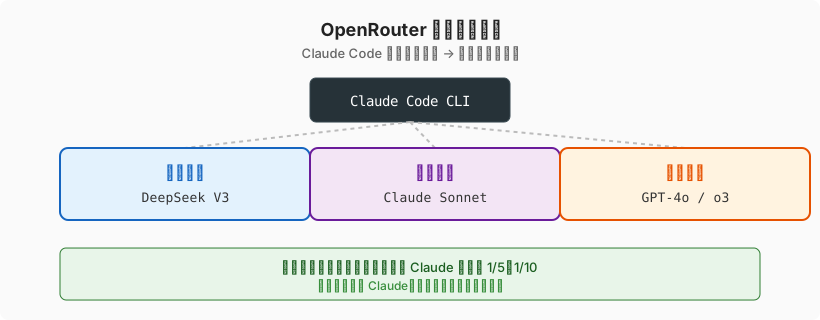
Everyday work → DeepSeek V3 / R1
Best for: filling imports, tweaking signatures, scaffolding unit tests, explaining existing code, formatting, simple CRUD. These tasks need little reasoning depth but fire constantly—that is where token spend piles up. Point ANTHROPIC_DEFAULT_HAIKU_MODEL at deepseek/deepseek-chat or deepseek/deepseek-r1; per-call cost is often a fraction of Claude Haiku.
DeepSeek scores near top-tier open models on code benchmarks, and tool calls pass through OpenRouter reliably. Caveat: very large multi-file refactors occasionally drift—switch back to Claude for that session instead of reverting globally.
Complex work → Claude Sonnet / Opus
Best for: cross-module architecture, splitting large PRs, security-sensitive edits, refactors that must follow project conventions. Set ANTHROPIC_DEFAULT_SONNET_MODEL to anthropic/claude-sonnet-4 (or ~anthropic/claude-sonnet-latest to track the newest release). Claude Code is optimized for Anthropic models—tooling, thinking blocks, and long context are most stable on this slot.
Rule of thumb: when three or more files move together, or public API surface changes, stay on Claude. Saving a few cents of tokens is cheaper than redoing a bad refactor.
Reasoning and debugging → GPT-4o / o3-mini
Best for: race conditions, performance bottlenecks, algorithm correctness, nasty regex and SQL tuning. Point CLAUDE_CODE_SUBAGENT_MODEL at openai/gpt-4o or openai/o3-mini. OpenAI models can be stubborn on chain-of-thought and math-style problems—useful as sub-agents for “think first, edit second” tasks.
# Lightweight daily work → DeepSeek
                export ANTHROPIC_DEFAULT_HAIKU_MODEL="deepseek/deepseek-chat"

                # Primary coding → Claude Sonnet
                export ANTHROPIC_DEFAULT_SONNET_MODEL="anthropic/claude-sonnet-4"

                # Sub-agent reasoning → GPT-4o
                export CLAUDE_CODE_SUBAGENT_MODEL="openai/gpt-4o"
| Task type | Recommended model | Slot variable | When to keep Claude |
|---|---|---|---|
| Completions, small edits, explain | DeepSeek V3 | ANTHROPIC_DEFAULT_HAIKU_MODEL | Not required |
| Multi-file refactors, architecture | Claude Sonnet 4 | ANTHROPIC_DEFAULT_SONNET_MODEL | Always |
| Concurrency / performance / algorithms | GPT-4o / o3-mini | CLAUDE_CODE_SUBAGENT_MODEL | Review before merge |
| Unattended CI | Claude Sonnet (fixed) | GitHub Action env | Avoid cheap-model hallucinations |
Cost comparison: direct Anthropic vs OpenRouter mixed routing
Exact prices move with model updates, but the ratios stay familiar. Mid-2026 ballpark (blended input + output):
- Claude Sonnet direct: roughly $3 / M input, $15 / M output—heavy agent days easily exceed $10
- DeepSeek V3 via OpenRouter: roughly $0.27 / M input, $1.10 / M output—same call volume often drops to one-fifth or one-tenth
- Mixed split (70% DeepSeek + 25% Sonnet + 5% GPT): monthly bills commonly land at 30%–40% of all-Claude usage
Real-world example: an indie developer using Claude Code two to three hours daily on Sonnet alone might see $80–120 per month; the mixed routing above often falls to $25–45 for the same workload, with no obvious quality drop on hard tasks. On teams, OpenRouter project keys and usage reports help leads set monthly ceilings before someone’s looped agent burns the budget.
If you are comparing overall AI tooling spend, see our 2026 vibe coding software pricing guide—IDE subscriptions and metered API usage are two different ledgers; ROI only becomes clear when you read them together.
CI and teams: OpenRouter scales with you
The official Claude Code GitHub Action supports OpenRouter too: set anthropic_api_key to your OPENROUTER_API_KEY, and add ANTHROPIC_BASE_URL: https://openrouter.ai/api in the step env. For unattended runs, pin Sonnet—do not put free-tier models on PR review; a hallucinated merge costs far more than tokens.
A common team pattern: each developer runs mixed routing locally; shared CI and review bots stay on fixed Claude; budgets roll up under one OpenRouter org account. If you run agent-style tools on a cloud Mac (OpenClaw, for example), the same variables can live in a launchd plist—see our cloud Mac OpenClaw launchd setup FAQ to keep keys out of scattered config files.
Troubleshooting checklist
- 401 Unauthorized: confirm
OPENROUTER_API_KEYis defined beforeANTHROPIC_AUTH_TOKEN; key should start withsk-or- - model not found: Base URL must not include
/v1; model IDs use OpenRouter format likeanthropic/claude-sonnet-4 - Still hitting Anthropic direct: run
/logout; setANTHROPIC_API_KEY=""as an empty string, not unset - Tool calls failing: retry on Claude Sonnet; check the OpenRouter dashboard for provider errors
- Slow responses: DeepSeek and some open models queue at peak hours; for interactive debugging, temporarily enable
/fastmode (requiresCLAUDE_CODE_SKIP_FAST_MODE_ORG_CHECK=1)
For fast mode, model aliases like ~anthropic/claude-sonnet-latest, and full GitHub Action samples, see the OpenRouter Claude Code tutorial.
Decision guide: keep Claude Max, or switch to OpenRouter?
If you use Claude Code more than an hour daily with a mix of small edits and occasional large refactors, OpenRouter mixed routing is almost always cheaper. Claude Pro / Max suits light users who prefer not to think about models while staying inside plan limits; once you regularly hit rate or usage caps, metered mixing wins on flexibility.
Rollout in three weeks: week one—change env vars only, swap the Haiku slot to DeepSeek, watch /status and your bill; week two—adjust Sonnet and sub-agent assignments based on failures; week three—move CI and team keys to an OpenRouter org. Do not point every slot at the cheapest open model on day one—the goal of claude code cheaper is saving money without gutting quality on work that matters.
On a cloud Mac mini, your AI coding stack stays stable
Claude Code plus OpenRouter feels most complete on macOS: native Unix terminal, Homebrew, Git, and SSH with no extra wiring. Move your main dev environment to a cloud Mac and bake API keys plus .claude/settings.local.json into the image—new machines boot ready, no reconfiguration marathon. Apple Silicon M4 unified memory helps local builds and concurrent agent work; idle draw around 4W makes long Claude Code refactors affordable to leave running.
Compared with similarly priced Windows remote boxes, cloud Mac minis mean fewer surprises around Gatekeeper, SIP, and code signing—when an agent reads and writes your repo and shells out constantly, OS stability decides how much you trust unattended runs. macOS’s low crash rate also suits overnight agent jobs.
If you are planning to move AI coding workflows onto reliable, high-performance hardware, VPSSpark cloud Mac mini M4 is a strong starting point—see plans and pricing and run Claude Code with OpenRouter on infrastructure built to stay up.