Last year we helped a B2B SaaS team ship an "all-in-one support agent": one system prompt packed pre-sales, post-sales, quoting, and troubleshooting personas, plus a twenty-page FAQ appendix. Week one, NPS looked great. By week three it was chasing upsell leads inside refund tickets and pasting internal codenames into customer-facing replies.
Nobody blamed the model for being dumb. The issue was blunt: we gave one worker four desks. In 2026 the industry consensus is settling—single agents are not obsolete, but they fit short tool chains and crisp boundaries. Once you enter research → spec → code → test → review → release—work that is multi-stage, parallel, and self-correcting—you should seriously model a multi-agent pipeline.
This piece skips "what is an agent" trivia and focuses on the migration path we see in OpenClaw, IDE agents, and internal PoCs: how a single agent spins internally, when to split into a team, and the three-layer stack teams actually run in 2026. If memory and cost are already on your mind, pair this with Agent Memory vs chat logs and team agent cost bills.
Single-agent era: great at playing roles, weak at collaborating
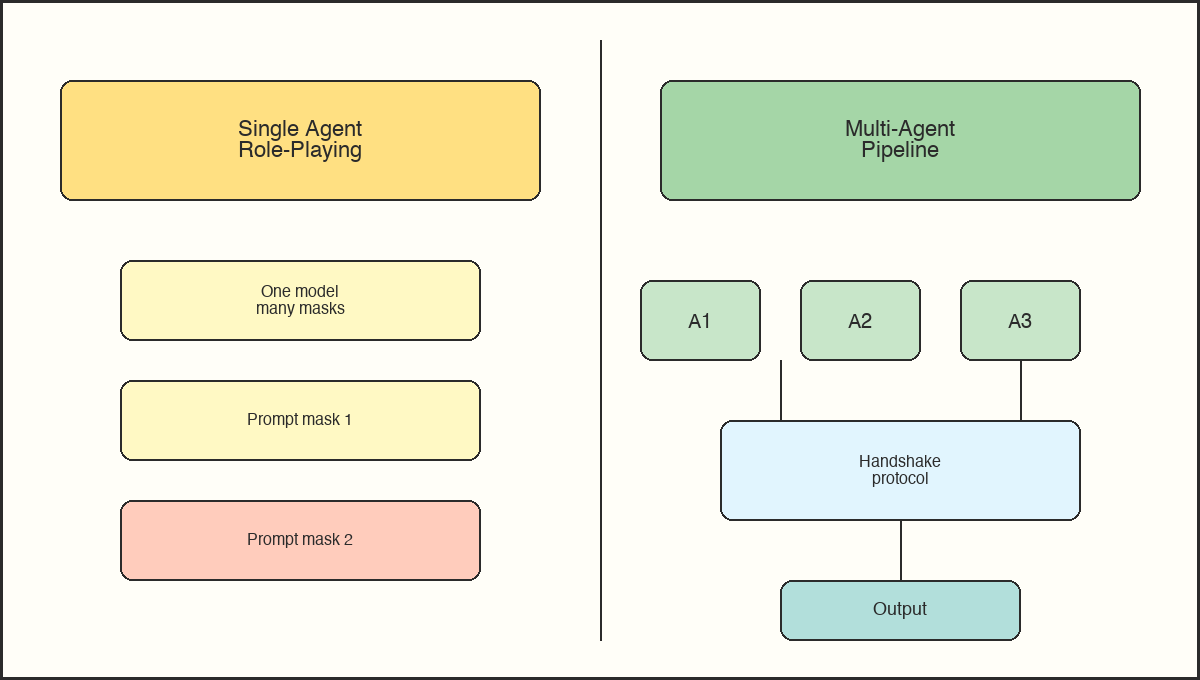
Early agent products competed on whose system prompt sounded most senior and whose persona switches felt smoothest. Stack "staff architect," "blunt reviewer," and "patient PM" into paragraphs and the model will change tone in one thread—that is single-agent role-playing.
Upside is real: one deployable unit, short traces, easy debugging. Cursor, Claude Code, and custom GPTs pushed this lane hard in 2024–2025.
The ceiling shows up just as clearly:
- Context pollution—research notes, diffs, and test logs share one window; later steps inherit earlier noise.
- Blurred ownership—when something fails you cannot tell whether planning or execution broke, so you cannot rerun just one stage.
- Zero parallelism—the model still thinks in one line while real teams search, implement, and test concurrently.
- Hard to split permissions—you do not want the coding agent and the production-database agent sharing one tool bundle; a single prompt cannot enforce that cleanly.
When the job shifts from answering a question to shipping a mergeable PR, thickening the prompt yields diminishing returns. That is not model regression—it is the shape of an engineering problem needing handoffs, contracts, and replay, not better adjectives.
Multi-agent era: from one actor in masks to handshake protocols
Multi-agent collaborative role-playing changes the metaphor: not one actor swapping masks, but several roles on stage, coordinated by script and director. Each agent owns a narrow mandate—Planner only decomposes, Coder only touches allowed paths, Reviewer reads diffs without permission to "fix two lines while here."
Alignment happens through three mechanisms:
- Shared state—plans, tree snapshots, test output, and todo lists live in graph state or a memory store, not scattered chat.
- Structured handoffs—step N emits JSON, patches, or checklists; step N+1 consumes only schema-valid fields instead of "see above."
- Termination and arbitration—done, escalate-to-human, and rollback are decided by an Evaluator or rule node, not whichever agent speaks last.
When we split that overloaded support bot into Intent Router, FAQ Retriever, Ticket Writer, and Escalation Guard, customer-facing internal jargon dropped to zero—not because we swapped models, but because Escalation Guard never received customer-facing tools.
Inside one agent: ReAct and layered anatomy
Before you hire a team, map the organs of a single agent. Whether you use LangChain, OpenAI Agents SDK, or Cursor, the skeleton in 2026 looks similar:
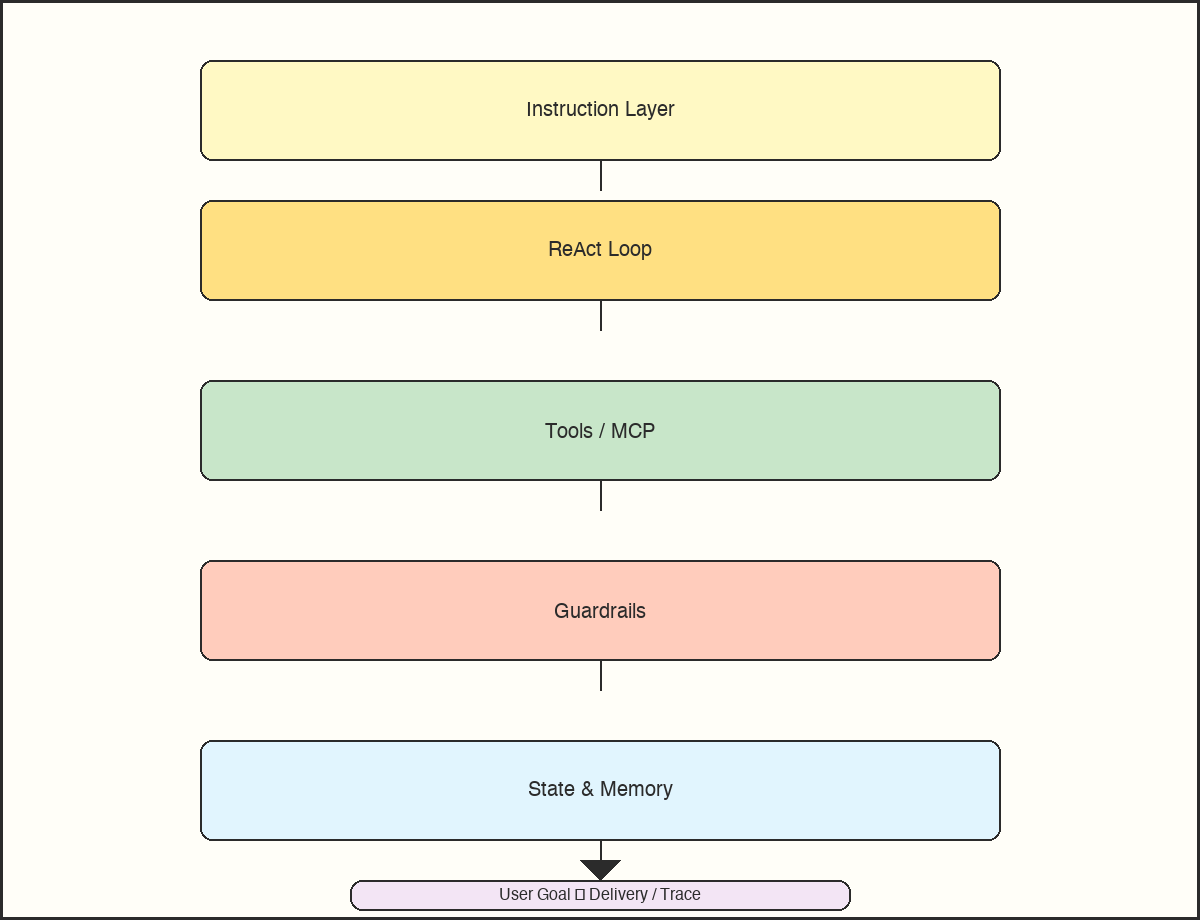
Read the diagram top to bottom:
- Instruction layer—system prompt,
AGENTS.md, and Skills translate user goals into enforceable constraints. Skills are reusable subroutines before you promote them to standalone agents. - ReAct loop—Reason → Tool → Observe. The model reasons, calls Bash / Browser / MCP / Search, reads results, reasons again. This is the heartbeat.
- Tools and runtime—filesystem, Git, and sandbox boundaries define what the agent may touch. MCP is the 2026 de-facto standard: wire a tool once, share it across agents.
- Deterministic guardrails—hooks, middleware, and evaluators block destructive actions, force tests, and validate schemas outside the loop.
- State and memory—plans, logs, and memory stores feed the next ReAct step from ground truth, not imagined progress.
Multi-agent design does not throw this diagram away—it duplicates boxes and wires them in a graph. A Planner node might be instruction plus light ReAct; Workers carry full tool access; a Judge may be evaluator-only with no write permissions.
LangGraph separates in-thread messages from cross-thread stores (memory concepts) because teams must decide whether agents share chat or versioned state objects.
Pipeline patterns: four topologies we actually draw
"Multi-agent" is not "more agents." We pick topology first, then headcount:
| Topology | How they cooperate | Typical use | Main risk |
|---|---|---|---|
| Sequential pipeline | A → B → C, one-way handoff | Research → spec → code → unit tests | Upstream errors force full reruns; need checkpoints |
| Supervisor–worker | Supervisor dispatches; workers report back | Parallel edits, map-reduce migrations | Supervisor context bloat; merge conflicts between workers |
| Debate / review | Proposal + critic rounds | Security audit, architecture choice, release notes | Empty debate burns tokens; cap rounds |
| Human-in-the-loop | Critical nodes interrupt for approval |
Production change, outbound mail, billing logic | State must persist while humans think—not on one laptop |
A clear 2026 trend: kick deterministic work out of the LLM. Formatting, lint, tests, and tagging belong in CI or hooks; agents think and draft. On cloud Mac runners we let agents submit diffs while xcodebuild always runs in isolation—the same "devs don't touch prod" rule traditional teams already enforce.
LangChain's multi-agent concepts model Supervisor, Swarm, and Handoff as graph edges—choosing the edge matters more than choosing the model.
2026 stack: Harness / Framework / Runtime
Once you have more than three nodes running in IDE, VPS, or cron, "one Python script stringing prompts" stops scaling. The industry is converging on three layers:
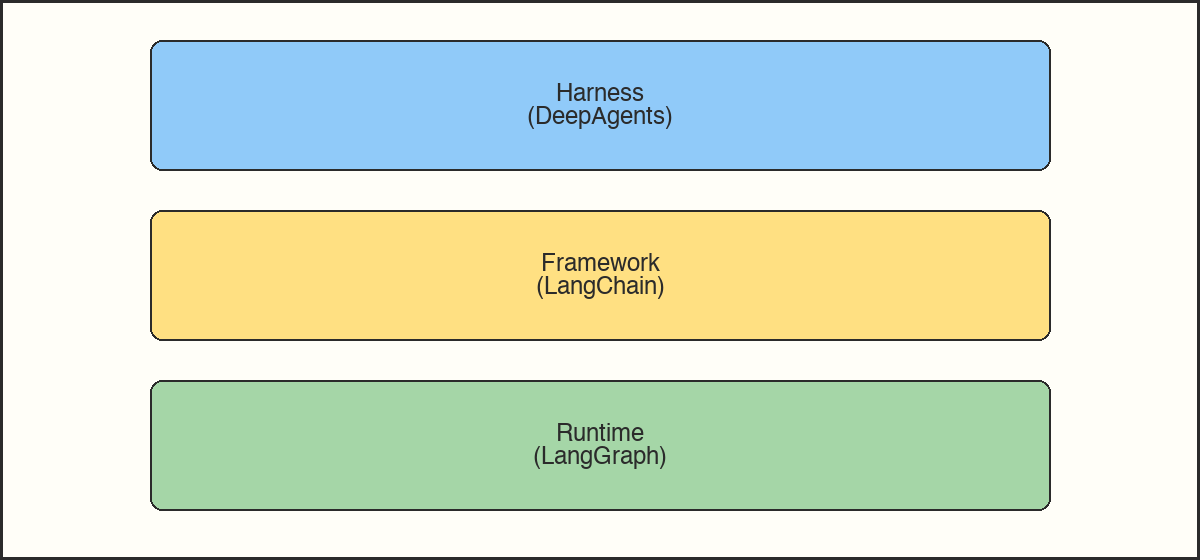
Runtime (LangGraph) answers which node runs next, where state lives, and how failures roll back. Cycles, parallelism, and durable checkpoints separate multi-agent systems from chained prompts. Official LangGraph models apps as Pregel supersteps—useful when you need global scheduling like a real team.
Framework (LangChain) answers how to call models, wrap tools, and plug RAG. It supplies parts without dictating topology. Many teams borrow only LangChain tool adapters and orchestrate entirely in LangGraph—that is normal.
Harness (DeepAgents and peers) answers how you test, deploy, and align with humans: trajectory eval, prompt A/B, permission sandboxes, integration with OpenClaw or Cursor hosts. Competition in 2026 is shifting from "whose agent is smartest" to "whose harness ships to production."
Landing checklist: from demo to maintainable pipeline
Our minimum checklist for internal pilots—vendor-agnostic:
- Draw a state graph, not an org chart—nodes are verbs; edges are data contracts. Avoid nodes named after people.
- Schema every handoff—JSON Schema or TypedDict so partial retries are possible.
- Minimize tools per node—reviewers read-only; only deployers touch production webhooks.
- One trace id end-to-end—tool calls, tokens, and latency per agent for replay.
- Tier memory—in-thread chat, cross-session memory, and vector RAG each own one job; do not let agents fight over one fact.
- Budget cost per node—large model for planning, small model or rules for formatting; multi-agent does not mean linear price growth.
Split execution too: we run OpenClaw gateways and light nodes on VPS, while xcodebuild, heavy browser automation, and large-repo indexing live on cloud Mac—so one machine is not simultaneously brain and muscle that goes offline when the lid closes. That is the same division-of-labor idea, just at the hardware layer.
You might also ask
Will single agents disappear?
No. Short-chain tasks—research, single-file edits, email drafts—often stay faster and cheaper with one agent plus Skills. Multi-agent is for complex delivery, not the default.
How do MCP and Skills fit?
MCP standardizes tool interfaces; Skills are capability modules inside one agent. In a pipeline, a Skill can graduate to its own node while tools stay shared via MCP instead of re-implementing GitHub five times.
Is OpenClaw multi-agent?
The gateway can orchestrate: channels, cron, and sub-agent configs form a light topology. Full graph orchestration usually still needs LangGraph or the host IDE's multi-agent mode; OpenClaw excels as a 24/7 execution surface.
Team collaboration needs team-grade execution
Moving from single agent to multi-agent is essentially splitting unmaintainable prompts into observable pipelines. Planner, Worker, and Reviewer need different tool permissions, runtimes, and failure policies—next step is gateway on VPS, heavy builds on cloud Mac, memory in a vault.
VPSSpark cloud Mac mini M4 instances fit Worker nodes that run long compiles and browser automation; Linux VPS hosts OpenClaw gateways and light cron. Smarter models do not automatically stabilize delivery—team the architecture first, then scale compute is the saner 2026 bet.
If you are wiring your first multi-agent pipeline, start with Mac cloud plans to offload build nodes from your laptop, or visit the home page for packages. The single-agent era trained prompts; the multi-agent era trains handoffs, contracts, and replay—language engineering teams already speak fluently.