
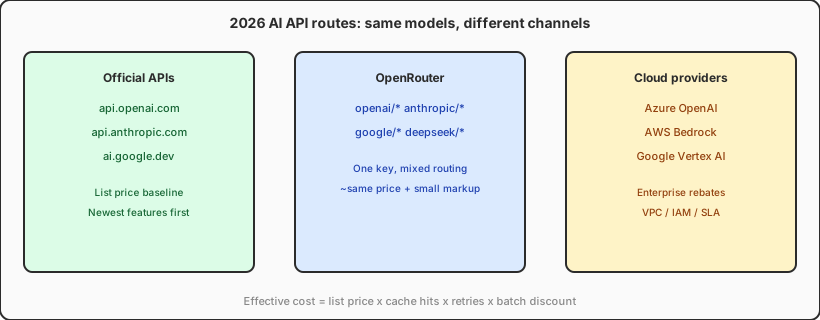
Bottom line: In August 2026, if you only ask which platform has the lowest sticker price, the answer often points to Google Gemini 3.5 Flash or DeepSeek routes on OpenRouter. If you ask which platform gives you the lowest production bill, the winner is determined by how you call the API — long-running agents, offline batch jobs, and multi-model routing each have a different cheapest path. Official APIs offer transparent list prices and the newest features; aggregators like OpenRouter excel at model switching; cloud providers (Azure OpenAI, Vertex AI, Bedrock) fit existing enterprise contracts and compliance needs.
This article is for three audiences: indie developers choosing their first production LLM backend; tech leads who need GPT, Claude, and Gemini without maintaining three billing relationships; and AI product teams paying thousands per month who want to know whether to stay on official APIs or move to OpenRouter or cloud resale channels.
Data checked August 3, 2026. List prices come from each vendor's official pricing page. Effective-cost estimates assume a typical agent workload with a 3:1 input-to-output ratio and 40% cache hit rate — your bill will vary with prompt structure.
A comparison framework: list price ≠ your bill
Every vendor publishes input and output rates per million tokens, but effective unit cost also depends on:
- Prompt caching — GPT-5.6, Claude, and Gemini all cache repeated prefixes at 10%–25% of list input price. Stable system prompts often save more than switching platforms.
- Batch / async — OpenAI Batch and Google Batch are typically half price for non-real-time work.
- Reasoning tokens — GPT-5.6 Sol, Claude Opus 4, and Gemini 3.1 Pro can burn 30%–60% of output cost in hidden reasoning when deep thinking is enabled.
- Retries and failures — timeouts, tool loops, and guardrail blocks bill on both official APIs and gateways. As we noted in our Kimi K3 Context Caching cost guide, high cache hit rate does not equal high task success rate.
- Gateway markup — OpenRouter is usually at or slightly above official pricing (5%–15%) in exchange for one key and fast model switching.
GPT: OpenAI official vs Azure vs OpenRouter
As of August 2026, OpenAI's production flagship is the GPT-5.6 Sol / Terra / Luna family (GA July 2026). Standard short-context rates (OpenAI API Pricing):
| Model | Input / M tokens | Output / M tokens | Cached input | Best for |
|---|---|---|---|---|
| gpt-5.6-sol | $5.00 | $30.00 | $0.50 | Complex agents, deep reasoning |
| gpt-5.6-terra | $2.50 | $15.00 | $0.25 | Daily chat, medium code tasks |
| gpt-5.6-luna | $1.00 | $6.00 | $0.10 | High-volume classification, routing |
Azure OpenAI matches list pricing; enterprise EA/MACC rebates of 5%–15% are common. Value is unified Azure billing and private networking, not a dramatic unit-price win.
OpenRouter routes openai/gpt-5.6-sol at or near official rates. The real win is one key for GPT, Claude, Gemini, and DeepSeek. If you already use OpenRouter to cut Claude Code costs, adding GPT to the same layer is nearly free integration work.
Claude: Anthropic official vs Bedrock vs OpenRouter
Main 2026 coding models: Claude Sonnet 4 and Claude Opus 4 (Anthropic Pricing):
| Model | Input / M | Output / M | Cache write | Cache read |
|---|---|---|---|---|
| Claude Sonnet 4 | $3.00 | $15.00 | $3.75 | $0.30 |
| Claude Opus 4 | $15.00 | $75.00 | $18.75 | $1.50 |
| Claude Haiku 4 | $0.80 | $4.00 | $1.00 | $0.08 |
Claude Prompt Caching requires explicit cache_control, but cache reads are 10% of input price — excellent for agents with stable 8K-token prefixes. At 50% hit rate, Sonnet 4 effective input can land near $1.65/M instead of $3/M.
AWS Bedrock lists the same rates plus AWS enterprise discounts. OpenRouter is the standard backend for Claude Code cost optimization at parity pricing.
Gemini: AI Studio vs Vertex vs OpenRouter
August 2026 API workhorses: Gemini 3.5 Flash (GA) and Gemini 3.1 Pro (Gemini API Pricing):
| Model | Input / M | Output / M | Context | Notes |
|---|---|---|---|---|
| Gemini 3.5 Flash | $0.15 | $0.60 | ~1M tokens | Cheapest high-volume tier |
| Gemini 3.1 Pro | $1.25 | $5.00 | Up to 1M | Complex reasoning, multimodal |
| Gemini 3.5 Pro (preview) | TBD | TBD | Target 2M | Vertex limited preview |
On list price alone, Gemini 3.5 Flash is the cheapest general API among the big three in 2026 — input is 15% of GPT-5.6 Luna and 19% of Claude Haiku 4. Flash is not always the right tool for complex multi-file agent work, where Sonnet 4 or GPT-5.6 Sol may cost less per successful task.
Three scenarios: who wins?
Scenario A: Long-session agents (500+ tool rounds/day)
Maximize prompt caching, not catalog price.
- Claude Sonnet 4 official + cache_control — best quality/cache-read balance for coding agents
- OpenRouter hybrid routing — cheap models for daily tasks, Sonnet for refactors
- GPT-5.6 Sol + prompt cache — if you are already on Responses API / Codex
Scenario B: Offline batch (10M+ tokens/day)
- Gemini 3.5 Flash + Google Batch — lowest list price, half again in batch
- GPT-5.6 Luna + OpenAI Batch — mature ecosystem
- Claude Haiku 4 + Message Batches
Scenario C: Multi-model routing in one product
OpenRouter — one key, one dashboard, GPT + Claude + Gemini + DeepSeek. Engineering time saved usually beats a 5% rate gap.
Hidden fees: five questions before you sign
- Long-context surcharges — GPT-5.6 above 128K is 2× input / 1.5× output.
- Cache write cost — Anthropic and OpenAI charge 1.25× input on first cache write.
- Priority / Flex tiers — OpenAI Priority is 2×; Flex is half price with queue risk.
- Egress — cross-region cloud egress can be $0.08–$0.12/GB.
- Minimum spend — some cloud resale channels require $1K/month commitments; OpenRouter prepaid has no minimum.
A five-minute decision path
1. One model family only? Yes → official API. No → OpenRouter or your existing cloud.
2. Main workload? Complex agent → Sonnet 4 or GPT-5.6 Sol + cache. Offline bulk → Gemini 3.5 Flash Batch. Light classification → Luna or Haiku 4.
3. Enterprise cloud contract? Azure → GPT on Azure OpenAI. AWS → Claude on Bedrock. GCP → Gemini on Vertex. None → official + OpenRouter is the most common combo.
There is no single "cheapest platform for everything" in August 2026 — only the cheapest combination for your call pattern. Export one week of logs, compute input/output ratio, cache hit rate, and retry rate, then use the tables above. That beats chasing another "10% price drop" headline.