
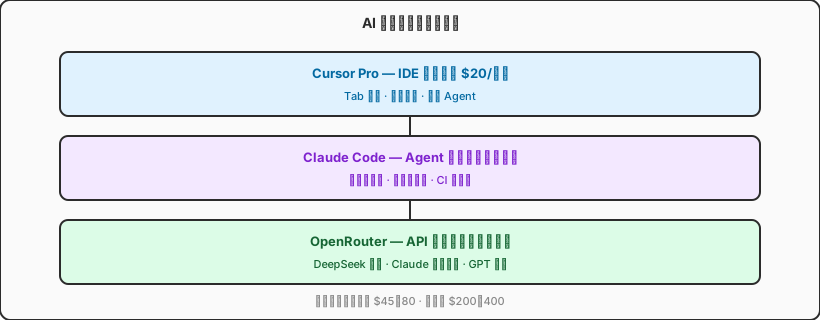
Bottom line first: If you are building a product, taking freelance work, or running a one-person company with AI in 2026, the most practical low-cost stack in August is Cursor Pro ($20/month fixed) for daily coding and Tab completion, Claude Code (usage-based) for repo-scale Agent work, and OpenRouter as the routing layer behind Claude Code—DeepSeek for everyday tasks, Claude for complex refactors, GPT for hard reasoning. Each tool owns a clear lane. Solo founders often land at $45–80/month, well under half of a “full Claude Max + Copilot + official APIs” setup, without giving up capability.
This article is for three audiences: indie developers just getting started who want to control AI tool spend; technical co-founders setting team budgets; and AI founders paying $150+/month who cannot explain where the money went. We break down Cursor cost and OpenRouter cost structure, share copy-paste monthly budget tables, and walk through the setup steps.
Pricing checked on August 4, 2026. Cursor and OpenRouter list prices come from each vendor’s official pricing page; effective-cost estimates assume a typical solo developer workload (3–4 hours of coding per day, 2–3 large Agent runs per week).
Why AI startups should layer tools—not buy the most expensive everything
By 2026, AI coding tools have split into three tiers: lightweight IDE assistance (Tab completion, inline edits), IDE Agent mode (multi-file edits, conversational refactors), and terminal-level repo Agents (full codebase reads, test runs, PRs). Capability climbs with each tier—and so does cost. Many people mix all three bills together and only at month-end realize they stacked “$20 subscription + $120 API + another $20 subscription.”
The more common waste is using the wrong tool for the job: Claude Opus to rename a variable, or Cursor Agent for an import that Tab completion could handle. Layering means fixed cost buys experience, variable cost scales with task severity. Cursor Pro’s $20 is a predictable floor for fast Tab completion and basic Agent use; anything beyond the plan allowance and Claude Code’s Agent calls go through OpenRouter on pay-as-you-go pricing, with mixed-model routing to keep per-token rates down.
We covered this in our AI Agent cost and billing guide: subscriptions and API usage are two different ledgers—only when you read them together can you see ROI clearly. This article is the concrete stack you can deploy today.
Cursor cost breakdown: $20 fixed + usage overages
As of August 2026, Cursor’s official pricing has three tiers:
- Free: Limited Tab completion and slower models—fine for trial, not for production.
- Pro ($20/month): Unlimited Tab completion, a monthly pool of fast model requests, and basic Agent mode. This is the default for solo developers.
- Business ($40/user/month): Team management, SSO, centralized billing. For a 3–5 person team, $40 per seat is the main fixed cost at the IDE layer.
The hidden part of Cursor cost is overage: once Pro’s fast requests are exhausted, Agent mode and premium model calls bill at API rates on top of the subscription. Many assume “monthly plan = unlimited” and only discover stacked charges at checkout. Two controls help: route heavy Agent work (refactors across five or more files, long debug loops) to Claude Code instead of Cursor; and in Cursor Settings, add a custom API key so overages route to OpenRouter rather than Cursor’s built-in billing—at least the unit price stays under your control.
For solo founders, Cursor Pro at $20/month is fixed spend worth keeping: Tab completion speed and context awareness remain first-tier; the time saved dwarfs $20. The discipline is not letting Cursor Agent do Claude Code’s job—the former fits “fix this function,” the latter fits “refactor this module and get tests green.”
OpenRouter cost breakdown: pay-as-you-go + mixed routing
OpenRouter is a model aggregation gateway: one API key reaches Anthropic, OpenAI, Google, DeepSeek, and dozens more, billed per token. For founders, OpenRouter cost wins on three points:
- No monthly minimum: Preloading $10–20 often covers a month—more flexible than Claude Pro or Max subscriptions.
- Mixed routing: DeepSeek for daily work, Claude for complex edits, GPT for reasoning—all on one bill, no three-account juggling.
- Budget caps: The dashboard lets you set monthly limits per key or project, so Agent loops cannot silently burn the budget.
August 2026 reference rates (input + output blended estimates):
| Model | Input / 1M tokens | Output / 1M tokens | Best for |
|---|---|---|---|
| DeepSeek V3 | ~$0.27 | ~$1.10 | Completions, small edits, explanations, test scaffolding |
| Claude Sonnet 4 | ~$3 | ~$15 | Multi-file refactors, architecture changes, security-sensitive edits |
| GPT-4o | ~$2.50 | ~$10 | Reasoning, debugging, algorithms, concurrency analysis |
For a fuller cross-platform comparison, see our 2026 AI API pricing comparison. Claude Code users get an Anthropic-compatible endpoint on OpenRouter—three environment variables and you are connected. We covered the details in Claude Code + OpenRouter cost guide; here we focus on stack-level budgeting.
Where Claude Code sits: variable-cost heavy artillery
Claude Code is a terminal-level AI coding Agent: it reads the whole repo, calls shell, runs tests, opens PRs. Cost compounds per turn with growing context—not one question, one answer. Each round resends the file tree, tool output, and conversation history. On direct Anthropic billing, power users can easily spend $10+ in a single day.
In the Cursor + Claude Code + OpenRouter stack, Claude Code’s role is:
- Not for: Daily Tab completion, single-line edits, quick explanations—leave those to Cursor.
- Built for: Cross-module refactors, large PR splits, unattended CI Agents, overnight long runs.
- Backend: OpenRouter mixed routing—Haiku slot → DeepSeek, Sonnet slot → Claude, sub-agents → GPT.
With that setup, Claude Code’s OpenRouter bill often lands at $15–40/month for solo developers—60%+ below $80–120 on pure Claude direct billing, with no drop in quality on hard tasks. Official integration docs: OpenRouter Claude Code integration guide.
Three monthly budget scenarios
Scenario A: Solo founder (one-person company)
3–4 hours of coding daily, 2–3 large Claude Code runs per week, occasional CI Agent jobs.
- Cursor Pro: $20 (fixed)
- OpenRouter (Claude Code backend): $15–25 (mixed routing)
- Cursor overages / other APIs: $5–10
- Total: $40–55/month
Compare that to “Claude Max $100 + Cursor Pro $20 + stray API $30” at $150+. The savings are real if you keep discipline: no large Agent runs inside Cursor, no Opus in Claude Code to rename a variable.
Scenario B: Small team (3 people, active MVP iteration)
Everyone on Cursor Business, one shared OpenRouter org account, Claude Code on CI plus local mixed routing.
- Cursor Business: $40 × 3 = $120
- OpenRouter shared pool: $60–100 (per-key budget caps)
- Cloud Mac / VPS (optional, for always-on Agents): $20–50
- Total: $200–270/month
Team playbook: local Claude Code with mixed routing per developer; CI and Code Review bots on fixed Sonnet; OpenRouter org account for centralized caps so one person’s loop cannot drain the pool. For Gateway-layer Virtual Key isolation, see cloud Mac + OpenRouter enterprise setup.
Scenario C: Ultra-bootstrap (freelance cash flow, tight runway)
Skip Cursor Business for now—one Pro seat, free tiers where possible, OpenRouter preloaded with $10.
- Cursor Pro: $20
- OpenRouter: $10–15 (strict caps, Haiku slot fully on DeepSeek)
- Claude Code only for tasks worth the tokens
- Total: $30–35/month
You trade some team workflow and Agent concurrency, but it is enough to validate a product. Move to Scenario A once cash flow improves.
Four steps: from subscriptions to mixed routing
Step 1: Subscribe to Cursor Pro and confirm Tab completion and basic Agent mode work. In Settings → Models, you can skip custom keys for the first week and just watch usage.
Step 2: Create an OpenRouter account, generate an API key at openrouter.ai/keys, preload $15–20, and set a monthly budget alert.
Step 3: Connect Claude Code to OpenRouter. Add the block below to ~/.zshrc or .claude/settings.local.json:
# OpenRouter API Key
                export OPENROUTER_API_KEY="sk-or-xxxxxxxx"
                export ANTHROPIC_BASE_URL="https://openrouter.ai/api"
                export ANTHROPIC_AUTH_TOKEN="$OPENROUTER_API_KEY"
                export ANTHROPIC_API_KEY=""

                # Mixed model routing
                export ANTHROPIC_DEFAULT_HAIKU_MODEL="deepseek/deepseek-chat"
                export ANTHROPIC_DEFAULT_SONNET_MODEL="anthropic/claude-sonnet-4"
                export CLAUDE_CODE_SUBAGENT_MODEL="openai/gpt-4o"
Step 4: Cursor overages (optional). If Pro limits hit often, add your OpenRouter key in Cursor Settings → Models as a custom provider so Agent overages route there too. Tab Completion still runs on Cursor built-in models—no replacement available.
Restart your terminal, run claude, and check /status—Base URL should show https://openrouter.ai/api. Keep the OpenRouter dashboard open for the first two weeks, watch per-model spend, then fine-tune slot assignments.
Common mistakes and the rules that prevent them
- Running Claude Code jobs inside Cursor: A ten-file refactor in Cursor Agent burns fast requests instantly, then bills overages at premium API rates. Move it to Claude Code + OpenRouter.
- Putting the cheapest model in every Claude Code slot: Keep Sonnet on CI and security-sensitive paths—rework time costs more than a few cents of tokens.
- Not tracking spend: Watch OpenRouter and Cursor overages separately; scan the dashboard weekly and investigate any model that spikes.
- Keys scattered everywhere: Centralize config in
~/.zshrcor a cloud Mac launchd plist—avoid per-project .env copies.
Stack more subscriptions—or adopt the three-layer setup?
If you pay $150+/month and cannot tie each dollar to a capability, the three-layer stack is almost always clearer: Cursor Pro buys IDE experience, OpenRouter buys elastic usage, Claude Code buys repo-scale Agent work. All-subscription stacks suit light users who do not want to think about models; once you regularly hit rate or usage caps, mixed pay-as-you-go is often cheaper and more flexible.
Practical rollout: Week one—Cursor Pro plus OpenRouter preload, Claude Code on direct Anthropic to baseline spend; week two—switch Claude Code to OpenRouter mixed routing, Haiku slot on DeepSeek; week three—route Cursor overages (if any) to OpenRouter and watch total burn in one dashboard. The goal is not the weakest model possible—it is keeping Cursor cost and OpenRouter cost in predictable bands without sacrificing quality on critical work.
On a cloud Mac, the three-layer stack stays stable
Cursor, Claude Code, and OpenRouter together feel most complete on macOS: native Unix terminal, Homebrew, Git, and SSH without extra setup. Move your main dev environment to a cloud Mac and API keys plus .claude/settings.local.json can live in the image—no reconfiguration every time you switch machines. Apple Silicon M4 unified memory handles local builds and Agent concurrency well; standby power around 4W makes it practical to leave Claude Code running on large refactors overnight.
Early-stage AI startups count every dollar—fixed cost for experience, variable cost by task tier, and the three-layer stack keeps those ledgers separate while preserving capability. When you run Agent tools on a cloud Mac, system stability is what lets you trust a long autonomous run.
If you are planning to move your AI coding workflow onto stable, cost-efficient hardware, VPSSpark cloud Mac mini M4 is a strong place to start—see plans and pricing and let Cursor, Claude Code, and OpenRouter run in a reliable environment long term.