
"Gemini 3.5 Pro is out—can I use it for free like ChatGPT?" That is one of the questions we hear most often after Google I/O 2026.
Short answer: As of July 15, 2026, Gemini 3.5 Pro is neither broadly available nor something you can treat as a free model. What most people can use at no cost today is Gemini 3.5 Flash. If you want a "Pro-level" experience, you either subscribe to Google AI Pro or pay per use through the API.
Below, we walk through Google Gemini pricing and limits in 2026 in this order: version comparison → consumer subscriptions → API billing → free-tier limits → how to choose.
First, the core question: Is Gemini 3.5 Pro free?
Not really—and most people still cannot use it.
At I/O 2026 in May, Google announced both Gemini 3.5 Flash and Gemini 3.5 Pro, but only Flash reached general availability (GA). 3.5 Pro remains in limited preview on channels such as Vertex AI, aimed at select enterprise customers. Regular users still cannot select it in the Gemini app.
So in practice:
- If you see "Gemini" in the app, you are usually on 3.5 Flash—and that line can be used for free;
- If you have heard about "3.5 Pro, 2M context, Deep Think," that is the next-generation flagship, expected to ship through Ultra subscription + premium API pricing. Official pricing has not been announced yet;
- The "Pro" model that is actually broadly available today is still Gemini 3.1 Pro, unlocked through a Google AI Pro subscription with higher usage limits.
Do not let the name fool you: "3.5 Pro" sounds newer than "3.1 Pro," but as of July 2026, what you can rely on is 3.1 Pro (subscription) and 3.5 Flash (free/low cost), not 3.5 Pro.
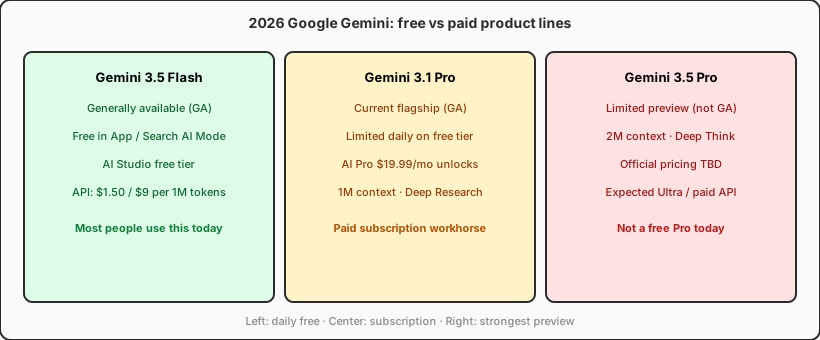
Google Gemini versions in 2026 at a glance
Google's naming is easy to get lost in: version numbers (3.1, 3.5), tiers (Flash / Pro), and entry points (App, API, Vertex) all stack on top of each other. Start with this table to build a mental model:
| Model | Status (Jul 2026) | Positioning | Context window | Typical entry points |
|---|---|---|---|---|
| Gemini 3.5 Flash | Generally available | Fast, affordable, daily workhorse | ~1M tokens | Gemini App, Search AI Mode, AI Studio, API |
| Gemini 3.1 Pro | Generally available | Current consumer flagship | Up to 1M tokens (subscription) | Gemini App (paid tier), API, Workspace |
| Gemini 3.5 Pro | Limited preview | Strongest reasoning + extra-long documents | Target 2M tokens | Vertex AI preview, future Ultra subscription |
| Gemini 2.5 series | Being phased out | Previous generation | Shorter | Some legacy integrations still in use |
How should you think about Flash vs Pro?
- Flash: Low latency and low cost—good for chat, search augmentation, agent tool use, and high-volume text processing;
- Pro: Deeper reasoning and stronger long-document and multimodal analysis—better for complex writing, code, and research reports;
- 3.5 Pro: Builds on Pro with Deep Think (multi-step reasoning mode) and 2M context for the hardest tasks.
Consumer subscriptions: How much does the Gemini app cost?
Individual users mainly access Gemini through gemini.google.com or the mobile app. In 2026, Google consolidated subscriptions under the Google AI / Google One umbrella. Common tiers look like this (USD pricing; regional differences may apply):
| Plan | Monthly price (approx.) | Models available | Main benefits |
|---|---|---|---|
| Free | $0 | 3.5 Flash + limited 3.1 Pro | Basic chat, limited daily image generation, a small amount of Deep Research |
| Google AI Plus | $7.99 | Expanded 3.1 Pro access | 200 GB storage, 200 AI credits, enhanced NotebookLM |
| Google AI Pro | $19.99 | High-limit 3.1 Pro | 1M context, 1,000 AI credits, Veo video, Code Assist, and more |
| Google AI Ultra | $99.99 | Highest access level | Deep Think, Project Mariner, agent workflows, 20 TB storage |
A few easy mistakes to avoid:
- The "Pro" in the free tier is 3.1 Pro, not 3.5 Pro—only a small number of complex questions per day are routed to 3.1 Pro. After that, you fall back to Flash or get an upgrade prompt.
- Subscriptions are tied to your Google account, not the API—paying for AI Pro in the app does not cover developer API billing. They are separate accounts with separate quotas.
- Student discounts—Google occasionally offers first-year AI Pro discounts (for example, $9.99/month). Check the official promotions page for current offers.
- 3.5 Pro is expected to land on Ultra first—once it opens broadly, Deep Think and 3.5 Pro are widely expected to sit on the Ultra tier rather than the free layer.
Developer API: How does billing work?
If you are building products, writing scripts, or wiring up automation, you go through Google AI Studio or Vertex AI. Like the ChatGPT API, you pay per token—use what you need, pay for what you use.
Published API pricing (Gemini 3.5 Flash)
Pricing confirmed at I/O 2026 for gemini-3.5-flash:
| Type | Price (per 1M tokens) |
|---|---|
| Input (text / image / audio, etc.) | $1.50 |
| Output | $9.00 |
| Context caching (when enabled) | Below standard input price |
For context (rough 2026 ranges for comparable model APIs): GPT-5.6 Sol is around $5 / $25, and Claude Fable 5 is around $10 / $50. Flash is very competitive on price-to-performance, which makes it a strong fit for agents, batch summarization, customer-support drafts, and other high-frequency workloads.
Gemini 3.1 Pro API
gemini-3.1-pro-preview is already listed in the public API catalog and priced above Flash (check Google's live pricing page for exact numbers). It suits scenarios that need stronger reasoning while you wait for 3.5 Pro to open broadly.
Gemini 3.5 Pro API
As of July 2026, Google has not published per-token API pricing for 3.5 Pro. Based on Flash pricing and historical Pro multipliers, outside estimates often land in the $12–15 input / $36–60 output per-million-token range—but that is speculation only. Wait for the model card at GA before you budget for production.
AI Studio free tier
One developer-friendly detail: you can start in Google AI Studio without a credit card. The free tier includes:
- About 60 requests per minute as a rate limit (free tier);
- A daily token quota (subject to Google's policy changes);
- Full access to gemini-3.5-flash, enough for prototypes and internal tools.
Once you exceed the free quota, you need billing enabled on a Google Cloud project. For production, enterprise compliance, and private-network deployment, teams usually move to Vertex AI.
Free vs paid usage limits
"Free" has never meant unlimited. Below are the common limit types on the consumer side and the API side in 2026:
Gemini app free users
| Capability | Free-tier limits (approx.) | What changes after upgrade |
|---|---|---|
| Daily chat | Defaults to 3.5 Flash; generous chat with fair-use policies | Pro subscription raises 3.1 Pro share and caps |
| Complex reasoning / long documents | Small daily 3.1 Pro allowance | AI Pro raises this significantly |
| Image generation (Nano Banana 2, etc.) | Daily image cap | Plus / Pro increase quota |
| Deep Research | About 5 reports per month on the free tier | Paid tiers add much more |
| Gemini Live voice | Available, but session length and count are limited | Ultra offers the highest limits |
| Context length | Standard Flash window | Pro subscription opens 1M-token class access |
Google rarely publishes fixed free-tier numbers on its marketing pages. Instead, it uses "dynamic limits + fair use": peak hours and complex multimodal requests are more likely to trigger "try again later" or an upgrade prompt. Real-world experience varies by account region and platform load.
API free tier
- Rate limits (RPM): about 60 RPM on the free tier; paid projects scale with project tier;
- Daily / monthly token caps: exceeding them returns 429; you need a card on file or a higher tier;
- Model availability: preview models can change IDs or retire at any time—lock a version in production;
- Data policy: free and paid tiers may differ on whether data is used for training; enterprise customers should read Cloud contract terms.
Compared with ChatGPT and Claude, is Gemini's "free" tier a good deal?
A side-by-side view helps with the decision:
| Google Gemini | OpenAI ChatGPT | Anthropic Claude | |
|---|---|---|---|
| Default free model | 3.5 Flash | GPT-5.x base tier | Claude base tier |
| Main subscription price | AI Pro ~$19.99 | Plus ~$20 | Pro ~$20 |
| Ecosystem tie-in | Search, Gmail, Docs, Android | Standalone + Microsoft | Standalone + developer-friendly |
| Low-cost API tier | Flash $1.50 / $9 | Varies by model | Haiku tier is relatively inexpensive |
| Longest context (flagship) | 3.5 Pro target 2M (preview) | Varies by model | Varies by model |
If you already live inside Google's productivity stack, free Flash plus Search AI Mode is close to zero marginal cost. If you want the strongest reasoning available today, 3.1 Pro subscription or a Claude / GPT flagship is still the more practical choice until 3.5 Pro opens broadly.
What should I choose? A decision table
| Your need | Suggested approach | Approximate cost |
|---|---|---|
| Occasional chat and quick research | Gemini app free tier + Search AI Mode | $0 |
| Heavy daily writing and research | Google AI Pro (high-limit 3.1 Pro) | ~$20/month |
| Building a demo or learning the API | Google AI Studio + 3.5 Flash | Starting at $0 |
| High-frequency calls inside a product | Gemini 3.5 Flash API | Pay-as-you-go, usually low |
| Very long PDFs / whole-codebase analysis | Wait for 3.5 Pro GA, or start with 3.1 Pro 1M context | Subscription or API |
| Agents running 24/7 on a server | API + VPS / cloud server | API + server |
FAQ
When will Gemini 3.5 Pro be publicly available?
After I/O 2026, Google has said "coming soon" several times. A GA target originally aimed at late June has slipped. As of mid-July 2026, the industry expects late July to August, but Google has not given a hard date. Watch the official Google AI blog and Gemini API model card updates.
I already pay for Google AI Pro—does that mean I get 3.5 Pro?
Not today. AI Pro mainly unlocks higher limits on Gemini 3.1 Pro plus add-ons such as Veo and Code Assist. When 3.5 Pro launches broadly, tier placement may change—but that is still ahead of us.
Are Gemini Advanced and Google AI Pro the same thing?
Google has consolidated branding over time: Gemini Advanced roughly maps to today's Google AI Pro tier. The older name still appears in some markets. Trust the model benefits shown at checkout.
Is it available in mainland China?
The Gemini app and API are unavailable or feature-limited in some regions, depending on account region settings and network conditions. Developers can also call models through Vertex AI projects in supported international regions. Check Google's terms of service and local regulations for specifics.
Can a free API key get stolen and abused?
Yes. Like OpenAI, do not put API keys in frontend pages, public repos, or screenshots. Abuse on the free tier is capped to some extent, but it can still get your project suspended or trigger unexpected billing after upgrade. In production, use environment variables, a backend proxy, and key rotation.
July 2026: Closing thoughts
Back to the headline: Is Gemini 3.5 Pro free?
- 3.5 Pro itself: not free, and most users still cannot access it;
- The broader Gemini ecosystem: there is a lot of genuinely free capability—3.5 Flash, AI Studio trials, Search AI Mode;
- The word "Pro": in July 2026, it more often means 3.1 Pro + subscription, not the 3.5 Pro you see in headlines.
If you simply do not want to spend more, get the most out of Flash and the free quotas first. If you are a developer, AI Studio + gemini-3.5-flash may be one of the best value on-ramps in 2026. Once 3.5 Pro reaches GA and pricing is public, you can decide whether 2M context and Deep Think are worth paying for—we will publish an updated comparison when that happens.
Bottom line: what is free is Flash, not 3.5 Pro; a subscription buys 3.1 Pro quota, not a bundled API plan; the API bills per token, separate from app subscriptions. Keep those three lines straight and you will stop asking, "I heard Pro was free—why is it asking me to pay?"
Automate with the Gemini API, run Apple development on cloud Mac
The Gemini 3.5 Flash API fits neatly into agents, support bots, and document pipelines. If your project also needs Xcode builds, iOS signing, or macOS-only toolchains, VPSSPark cloud Mac covers the Apple side.
Cloud Mac mini M4, billed monthly—built for remote macOS development and CI build queues. The API handles how you call the model; cloud Mac handles how you run the Apple stack.